Understand
Read a principle and work through a fictional situation.
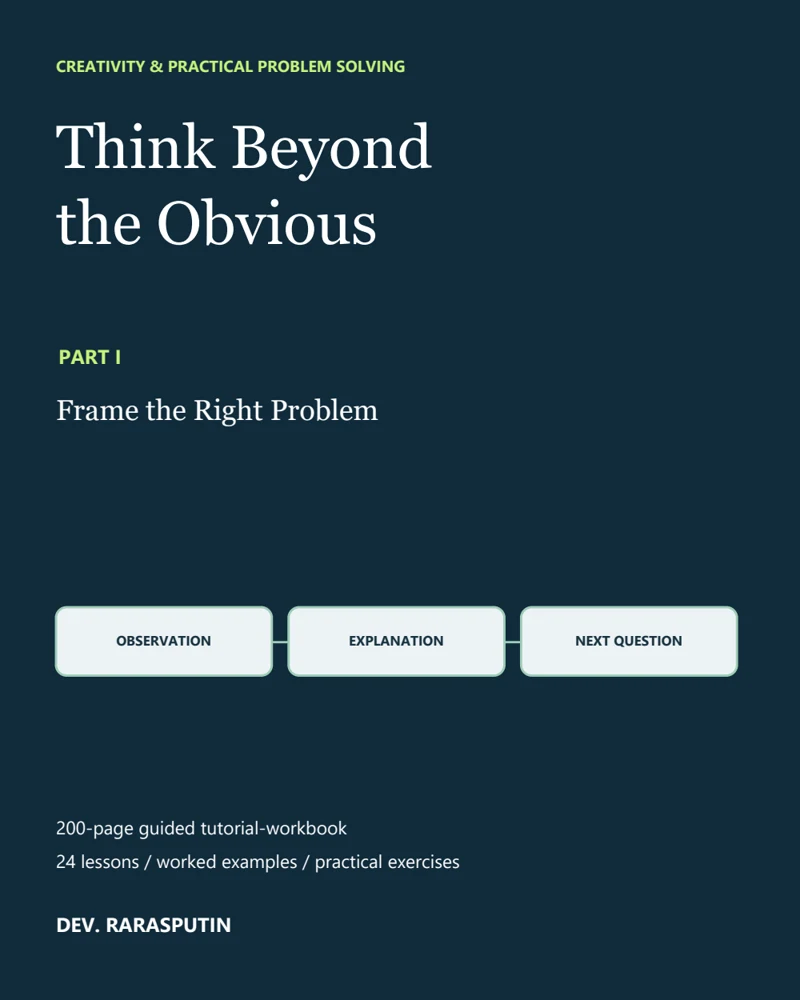
Creativity & practical problem solving / Part I
Discover the real need before choosing a solution.
200-page tutorial-workbook / 24 lessons / $5 USD
Get Part I - $5Substantial guided writing and planning space. PDF plus practical templates; each part is sold separately.
Learn by doing
Read a principle and work through a fictional situation.
Inspect two routes and the assumptions behind them.
Apply the skill to one manageable real challenge.
Record evidence, limits and your next useful decision.
A fictional worked example
Asha keeps missing a community workshop because the joining details arrive in several messages.
The problem becomes finding the current joining details before leaving home, rather than becoming a more organized person.
A shared confirmation card might help; so might one consistent message. Neither is proven yet.
Illustrative teaching example, not a testimonial or measured result.
Explore the sample lessonInside this volume
A useful problem starts with a specific repeated difficulty, not a verdict about your ability. Describe an event, the person affected and the consequence. Keep an irritation separate from the cause you suspect.
Try it: Describe one recent friction without using lazy, hopeless or always.
Check: Could another person recognize the event from your description?
An observation records something you saw, heard or measured. An explanation proposes why it happened. Both can be useful if they are visibly different. Mark information you do not have instead of filling it with a confident story.
Try it: Split a current complaint into observed details and interpretations.
Check: What would you need to see before accepting your explanation?
A task matters because someone is trying to accomplish something in a particular situation. Ask what successful completion enables. Avoid assuming that your preferred process is their goal.
Try it: Describe one user's situation using their goal rather than your product.
Check: Whose experience is missing from your current description?
A symptom is an effect you notice; a cause is a proposed mechanism that produces it. The same symptom can have several causes. Treat causal statements as claims needing evidence rather than rewards for asking enough questions.
Try it: Create three possible causes for one recurring symptom.
Check: Which link in your causal story is still only a guess?
A process map makes handoffs, waiting and repetition visible. Record what happens now, including workarounds. Mapping an ideal sequence first can conceal the source of friction.
Try it: Map a familiar process in six to ten plain-language steps.
Check: Where does work stop, return or wait for a handoff?
An outcome describes a change that matters to someone. An output is something you produce. A new guide is an output; newcomers completing their first booking is an outcome. Keep them separate when deciding what to build.
Try it: Rewrite one planned deliverable as the improvement it should enable.
Check: What would change for a person if the output worked?
A scope names what this effort will address and what it leaves for another effort. It protects a small investigation from expanding into a total life redesign. Narrowing is useful only when the remaining problem still matters.
Try it: Write an in-scope and out-of-scope statement for a current problem.
Check: Would solving this smaller question still help?
Constraints limit feasible action; preferences express what someone would like. Some constraints are fixed and others negotiable. Identify the owner and evidence for each before treating an inherited habit as a rule.
Try it: Classify five limits as fixed, negotiable or preferred.
Check: Which constraint have you verified rather than inherited?
A baseline records the current situation before a change. It helps you avoid judging a new approach against a remembered worst day. Use a modest record suited to the task; it need not be a research study.
Try it: Keep a short baseline for one low-risk recurring task.
Check: What comparison would be fair to the current approach?
A problem may involve several people who hold different authority. Distinguish who experiences the issue, who can approve a change and who performs the work. An attractive idea can fail if no one owns the next action.
Try it: Map the roles for one change you want to suggest.
Check: Who must agree before your proposed experiment starts?
Specific recent examples show timing, workarounds and consequences that broad opinions can hide. Ask someone to walk through an occurrence. Avoid leading them toward the solution you already favor.
Try it: Write three neutral questions about a recent experience.
Check: Which example changed your understanding of the task?
Observation can reveal an action, pause or workaround. It does not reveal a person's private motive by itself. Ask permission where appropriate and keep identifying details out of your notes.
Try it: Describe three actions without assigning emotions or motives.
Check: What did you observe and what did you infer?
People can want different things from the same arrangement. Write each need in its own terms before proposing a compromise. A loud preference should not erase a less visible access requirement.
Try it: Map two conflicting needs and one shared interest.
Check: Which need cannot be met by the current proposal?
A creative question should invite several approaches while retaining the observed need. A question that already specifies an app, campaign or workshop narrows the answer prematurely.
Try it: Rewrite a solution-shaped question into three outcome-focused versions.
Check: Can you imagine different mechanisms that answer your question?
A brief should help another person understand the challenge without a long explanation from its author. Ask them to restate it. Their interpretation can expose an ambiguous goal or missing boundary.
Try it: Give someone a short brief and compare their restatement with your intent.
Check: Which word produced the largest difference in interpretation?
An assumption is something the plan relies on without adequate confirmation. Naming it makes the idea easier to test. Include assumptions about resources, behavior and permission rather than only technical performance.
Try it: Create an assumption list for one modest proposal.
Check: Which assumption would overturn the plan if false?
A boundary condition identifies what a proposed change must preserve. It can be accessibility, reliability or an existing commitment. This helps generate alternatives that solve the new problem without damaging something already useful.
Try it: Write two things your change should improve and two it must preserve.
Check: Which existing benefit is easy to lose by accident?
A single event can be framed as a communication, coordination, access or capacity issue. Each frame makes different alternatives visible. Compare them before choosing one; a frame is a lens rather than a fact.
Try it: Write three distinct frames for one situation.
Check: What does each framing reveal and conceal?
A large uncertainty can often be divided into a question that can be answered soon. The question should change the next decision. Avoid measuring something merely because it is easy to count.
Try it: Turn a broad uncertainty into one answerable next question.
Check: What will you do differently after learning the answer?
A belief becomes more useful when you can name conditions that would lead you to revise it. This prevents the investigation from becoming a search for agreement. Use realistic evidence, not impossible proof.
Try it: Write one belief and an observation that would challenge it.
Check: Would you accept this evidence if it favored the other option?
A useful statement combines the affected person, context, observed difficulty, consequence and intended outcome. Keep proposed solutions separate. Readers should be able to see both what is known and what remains uncertain.
Try it: Write a problem statement that fits within five sentences.
Check: Which sentence is evidence and which is an inference?
Not every irritation deserves a project. Select a challenge that matters, falls within your influence and can be explored responsibly. Leave a larger issue visible if the small challenge is only a first step.
Try it: Select one challenge and explain why now is a sensible time.
Check: Why is this challenge worth a small investigation?
Before generating solutions, check that affected people recognize the problem description. Invite corrections and missing perspectives. Agreement on a brief can remain provisional as new evidence appears.
Try it: Ask for one correction rather than asking whether your brief is good.
Check: What changed after someone affected reviewed the frame?
A completed brief is a working agreement for the next stage, not proof that the problem is fully understood. Include the question, evidence, boundaries and open assumptions so idea generation stays connected to reality.
Try it: Prepare a one-page brief and a short note about what could change it.
Check: Can you begin generating ideas while clearly naming the remaining unknowns?
Your working space
Choose a lesson, describe your challenge and keep the reasoning visible. Save stores entries in this browser only. Download a copy for another device. There is no account or cloud sync.
The complete learning path
Each volume contains 200 numbered pages, including substantial practice and writing space. This is a tutorial-workbook series, not a video course or interactive PDF form. Ordinary examples are fictional. Results depend on context, judgment and practice.